Stormwater Management Plan
On April 30, 2003, the University of Louisiana at Lafayette was declared a co-permittee to discharge stormwater under a general permit issued to the Lafayette Consolidated Government (“LCG”) by the Louisiana Department of Environmental Quality (“DEQ”). As a co-permittee, UL Lafayette is designated as a Municipal Separate Storm Sewer System (“MS4”). As a co-permittee with LCG, the MS4 is relying on another government entity to satisfy some permit obligations. Other co-permittees are the Lafayette regional airport and the cities/towns of Scott, Youngsville, Carencro, Duson, and Lafayette.
Areas of UL Lafayette are located in Lafayette, St. Martin, Acadia, and Iberia Parishes, and on the border of St. James and Lafourche Parishes. However, only University property within Lafayette Parish is included in the urbanized areas identified as an MS4 by DEQ.
As of December 2024, the University of Louisiana at Lafayette's New Iberia Research Center's (NIRC) campus began the process to become a co-permittee of New Iberia Parish. As a co-permittee, UL Lafayette NIRC will be designated as a Municipal Separate Storm Sewer System (“MS4”) and has a Stormwater Management Plan. Other co-permittees are the City of New Iberia, Village of Loreauville, and Iberia Parish.
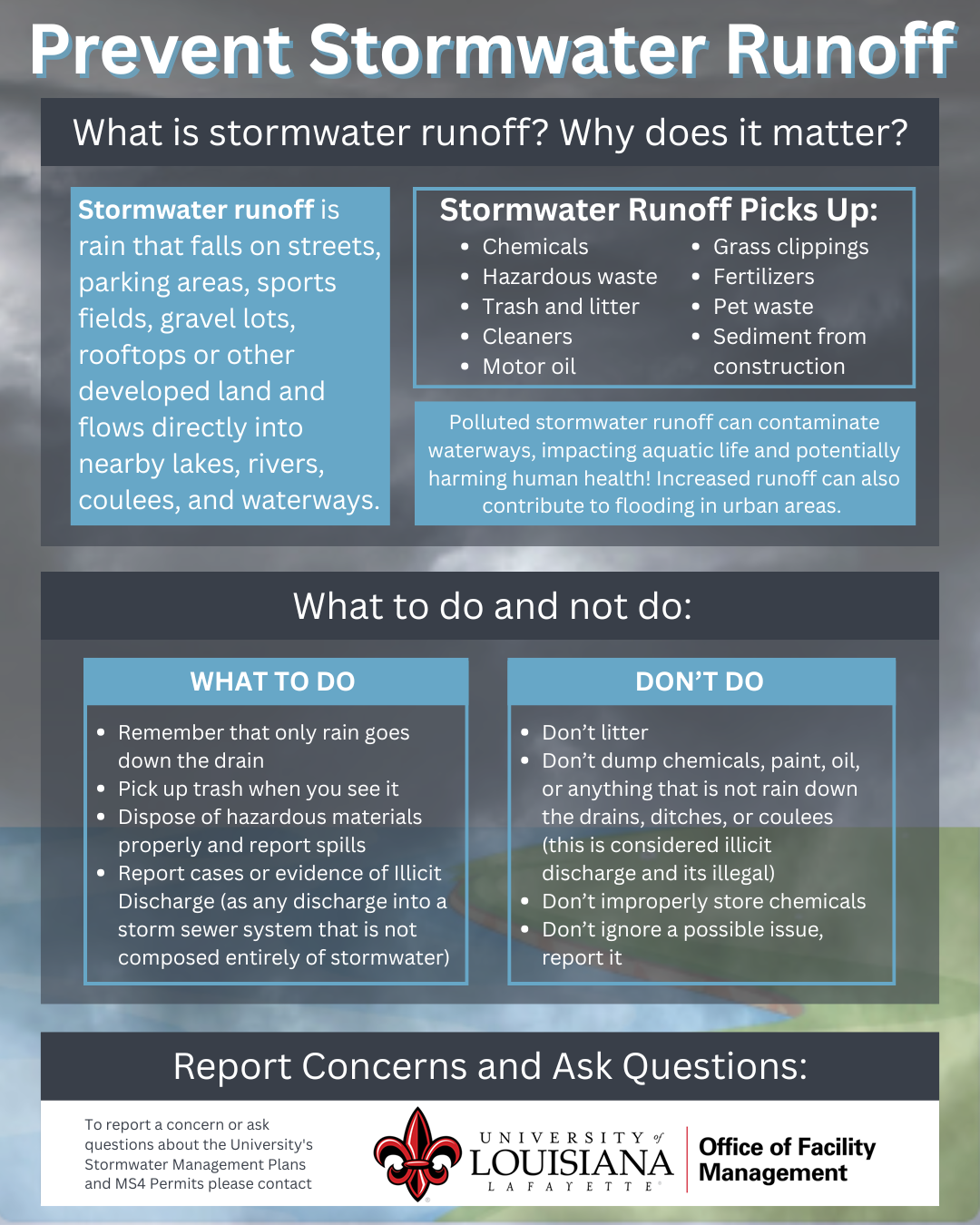
The Office of Facility Management manages the University's SWMP and MS4 Permit. A good rule of thumb to remember is "only rain down the drain". If you have any questions or have any violations to report, please contact Facilities.
What is an MS4- Municipal Separate Storm Sewer System?
According to 40 CFR 122.26(b)(8), "municipal separate storm sewer means a conveyance or system of conveyances (including roads with drainage systems, municipal streets, catch basins, curbs, gutters, ditches, man-made channels, or storm drains) under Section 208 of the Clean Water Act, that discharges into waters of the United States. An MS4 is not only a system of underground pipes, but can include roads with drainage systems, gutters, and ditches. The University is responsible for best management practices by tracking measurable goals on University property in Lafayette Parish and by engaging with the campus community.
University of Louisiana at Lafayette's latest: Annual Report
What is a Stormwater Management Plan (SWMP)?
A SWMP is a plan that addresses the long-term effect of development on stormwater quantity or quality and satisfies the requirement for post-construction water quality maintenance in an EPA or LDEQ stormwater discharge general permit. This Stormwater Management Plan (“SWMP”) is a “living” document intended to be revised and updated as needed, but at a minimum, annually. The University's SWMP primary goals are to reduce pollutant discharges, to protect water quality, and to satisfy the appropriate water quality requirements and the Clean Water Act. To meet these goals, the stormwater program ensures that stormwater quality management policies and best management practices will be implemented by the University.
University of Louisiana at Lafayette's latest: Stormwater Management Plan (SWMP)
Violations
Grass clippings and leaves blown or swept into storm drains or into the street harm waterways and our river, and are not allowed. Anything that is not rainwater is not allowed in the storm drains, coulees, ditches, or waterways. This is regulated by multiple laws, and violators could be fined. Applicable laws and ordinances are the 1972 Clean Water Act, 33 U.S.C. §1251 et seq., the 2006 Louisiana Law - RS 30:2531, and LCG's Stormwater Ordinance. For more resources about our local watershed and best practices, please visit LCG's Water Quality Information Website.
Keep in mind that glitter is litter. Non-biodegradable confetti and glitter are not allowed on campus. Small litter like confetti and glitter is hard to pick up and will often make its way into local stormwater systems and waterways. When litter gets into the local stormwater system, it enters the Vermilion Bayou in Lafayette, which then leads to the Gulf of Mexico. We must protect our waterways from litter and other pollutants.
Litter in waterways can prevent beneficial uses, lead to flooding issues, degrade habitats, harm wildlife, and may endanger public health. Illicit discharge is any discharge to a storm drain that is not composed entirely of stormwater. If you see stormwater contaminants or someone intentionally littering or dumping anything into campus drains, coulees, or in Cypress Lake, please contact Facilities.